In cross-border e-commerce and international trade, shipping costs are rarely calculated based on pure mass alone. Procurement managers sourcing goods from Chinese suppliers frequently face unexpected freight invoices due to a fundamental logistics billing rule: the dual-rate Chargeable Weight system.
Understanding the exact mechanics of volumetric weight calculation in China — and how professional consolidation warehouses neutralize dimensional penalties — is critical to protecting profit margins and optimizing total landed costs.
1. What Is Chargeable Weight? (AGW vs. VW)
International air carriers, ocean express lines, and regional last-mile couriers operate under strict spatial and structural weight limits. To balance physical cargo weight against spatial volumetric capacity, carriers bill based on whichever metric is greater:
Chargeable Weight = MAX (Actual Gross Weight, Volumetric Weight)
- Actual Gross Weight (AGW): The physical mass of the cargo measured on a commercial scale, including internal retail boxes, bubble wrap, and outer master cartons.
- Volumetric Weight (VW / DIM Weight): A calculated metric representing the space cargo occupies relative to its physical density, using carrier-defined volumetric divisors.
2. Industry Standard Formulas for Volumetric Weight Calculation in China
Depending on the transport mode — express courier, air freight, ocean LCL, or China–Europe railway — carriers apply different volumetric divisors:
- Express Courier (DHL, FedEx, UPS) — Formula: L × W × H ÷ 5000 — Divisor: 5000 — Billable on: MAX(AGW, VW)
- Standard Air Freight (IATA baseline) — Formula: L × W × H ÷ 6000 or ÷5000 — Divisor: 6000 / 5000 — Billable on: 1 CBM ≈ 167 kg
- Ocean Freight (LCL) — Formula: L × W × H ÷ 1,000,000 = CBM — Divisor: 1 CBM = 167 kg — Billable on: shifts to AGW if 1 CBM > 500 kg
- China–Europe Railway — Formula: L × W × H ÷ 6000 — Divisor: 6000 — Billable on: standard rail consolidation ratio
(All dimensions in centimetres: Length × Width × Height)
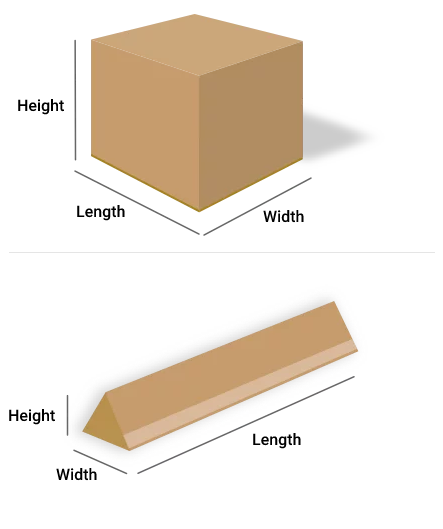
3. Interactive Volumetric Weight Calculator
China Cargo Volumetric Calculator
4. Real-World Sourcing Examples: Unconsolidated vs. Repacked Cargo
To demonstrate the financial impact of dimensional penalties during multi-supplier sourcing in China, consider the following real-life operational comparison:
Scenario A: Raw Factory Packaging (Bulky Winter Apparel)
An e-commerce importer purchases 500 winter coats from a factory in Ningbo. The supplier packages them directly into standard uncompressed single-wall master cartons:
- Package Count: 10 master cartons
- Dimensions per box: 60 cm × 50 cm × 50 cm
- Actual Gross Weight (AGW): 8 kg per carton (Total AGW = 80 kg)
Air Express Calculation (Divisor 5000):
- Volumetric Weight per box = (60 × 50 × 50) ÷ 5000 = 30 kg
- Total Volumetric Weight = 30 kg × 10 = 300 kg
Financial Penalty: The client pays for 300 kg of chargeable weight instead of the physical 80 kg. Over 220 kg of freight spend is wasted on empty cubic space.
Scenario B: China Consolidation Hub Optimization (Density Harmonization)
Instead of direct shipping, the parcels are routed to a specialized 4PL consolidation warehouse in Shenzhen:
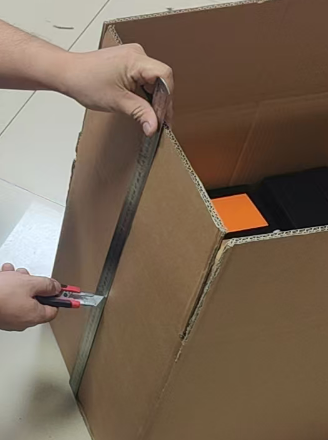
- Vacuum Compression: Soft goods are vacuum-sealed, reducing volume by up to 60%.
- Product Nesting: Compressed textiles are co-packed alongside dense metal accessories (e.g., hardware fittings).
- Carton Trimming: Master boxes are cut down to fit exact cargo volume, eliminating top box bulge.
Optimized Consolidated Metrics:
- Package Count: 4 reinforced master cartons
- New box dimensions: 50 cm × 40 cm × 40 cm
- Combined Actual Gross Weight: 120 kg (apparel + heavy hardware)
- New Volumetric Weight = (50 × 40 × 40 ÷ 5000) × 4 = 64 kg
Financial Savings: Because Actual Gross Weight (120 kg) now exceeds Volumetric Weight (64 kg), the billable weight is 120 kg. Volumetric penalties are reduced to zero while consolidating two distinct factory SKUs into one clearance filing.
5. How China Parcel Consolidation Optimizes Freight Efficiency
A specialized cross-border 4PL partner uses systematic packaging engineering to minimize volumetric weight calculation penalties in China:
- Removal of Supplier Tare Packaging: Eliminates oversized factory boxes, inner filling paper, and redundant double-boxing.
- Density Harmonization (AGW ≈ VW Balancing): Pairs high-density goods (heavy items) with low-density products (soft/bulky items) in identical master boxes to achieve maximum spatial efficiency.
- Customs Manifest Consolidation: Unifies multiple supplier packages into a single Master Airway Bill (MAWB) or Ocean Bill of Lading, saving administrative and last-mile clearance fees.
6. Pre-Shipment Audit Checklist for Sourcing Managers
Enforce this checklist with your China freight forwarder prior to dispatch:
☐ Outer Bulge Verification: Measure cartons from their maximum bulging points rather than flat edges.
☐ Carrier Divisor Audit: Confirm whether your contract applies a 5000 or 6000 divisor based on shipment mode and service level.
☐ Corner & Top Trimming: Mandate carton cutting to eliminate top air cavities before final taping.
☐ Pallet Profile Fitting: Ensure palletized cargo fits standard Unit Load Device (ULD) contours without overhang charges.